
Sans titre
Sans titre
Sans titre
histoire du chateau
Sans titre
Sans titre
The History of Avanton Castle
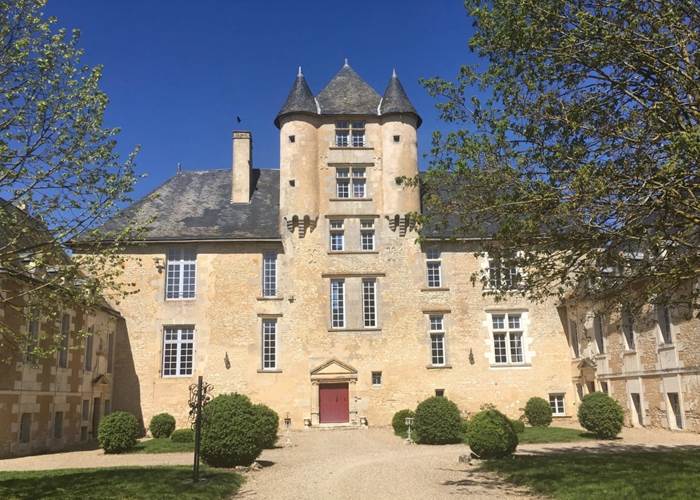
Built upon the foundations of an older structure, the Château d'Avanton was erected in the 16th century by François Aubert, mayor of Poitiers. Its architecture and decoration bear witness to the various families who subsequently owned the estate. This structure appears to have been conceived as an initial barrier against the winds that swept across the plain along the road connecting Richelieu to Poitiers. Its imposing height and balanced form make it a jewel of Renaissance history and architecture.
The architecture and decoration of the castle are associated with the history of the main families who succeeded one another on the estate.
At the end of the 13th century, writings attest to the presence of a church (parish of Avanton mentioned in 1325) and a hostel, a small manor house in the fields.
The lord of Avanton at the beginning of the 14th century was Jehan de Chouppes. The Lordship of Avanton was dependent on the Lordship of Beaumont. In 1346, Jehan de Chouppes donated the manor and the Lordship to the Order of the Hospitallers of Saint John of Jerusalem, the future Order of Malta. The foundations of the current castle form the base of the commandery, whose chapter house was probably located in the immense cellar on the first level, lit by large windows flush with the floor. Below, a second cellar, with ventilation shafts, is extended by a smaller cellar, hewn directly into the rock.
In 1383, the donation (though pure, absolute, and irrevocable) was revoked, and Regnault de Nanteuil, prior of the Ospital, bequeathed the manor and the Lordship of Avanton to Jehan Labbé. They remained in his family for a century, through his sons and daughter: Jehan Labbé in 1422, Lord of Avanton, then Guy Labbé, a priest, and then Jehanne Labbé. The descendants of the latter (Lord of La Viaudière) ceded part of the estate to Jacques Giboureau, the new Lord of Avanton in 1482. He died in 1505 without issue, the lordship was divided, and his heirs ceded the entire estate, manor and lordship, in 1509 to François Aubert, custodian of the salt tax in Poitou and Saintonge. Upon his death (1525) his wife Jeanne Clabat inherited, then his son François Aubert², in 1540.
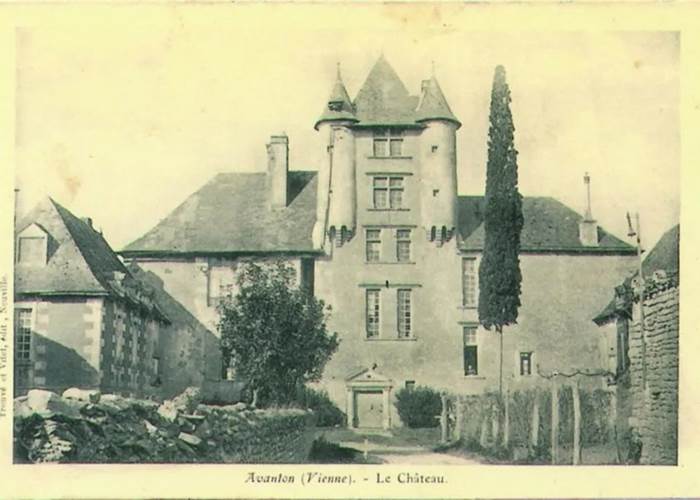
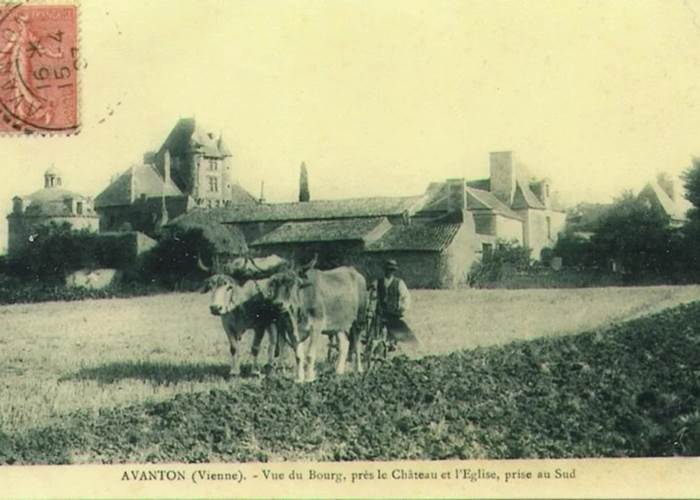
François Aubert, brother-in-law of Fumé (who built the Hôtel Fumé, or Hôtel de la Prévôté, on Rue de la Chaîne in Poitiers), became Lord of Avanton through the declaration he made in 1541. A councilor to the King in Poitiers, a councilor of the Parliament of Paris, and First President of the Seneschal's Court in Poitiers in 1551, he was tasked in 1559 with drafting the articles of the customary law of Poitou, and then mayor of Poitiers from 1564 to 1565. He was responsible for the construction of the castle and the dovecote in the mid-16th century. The central part of the castle, with its tower containing the double-flight staircase and the keep adorned with two corbelled turrets, and two adjoining buildings, is attributed to him. Its construction is, of course, much more modest than the nearby Château de Bonnivet (in the commune of Vendeuvre), which, with its 374 windows, had hosted Francis I and his mother, Louise of Savoy, and which Rabelais mentions in The Abbey of Thélème, before Chambord and Chantilly. But, unlike Admiral de Bonnivet, who died at the Battle of Pavia, François Aubert would have the good fortune of seeing his château pass into posterity!
Upon his death in 1569, his daughter Louise, later Madame de La Bruyère, became the owner of the château. In 1637, Guillaume de La Bruyère, through an exchange, ceded it to Claude Duflos, a Poitevin by adoption and a recently ennobled burgher of the town. A wealthy financier, Duflos enlarged the château to give it its current appearance: he commissioned Bertrand Jardel, the king's architect in Poitou, to build two pavilions at right angles, and he personally oversaw the work by Nicolas Foulon, master mason of Dissay, in 1640.
The château came into the Fay-Peyraud family through the marriage in 1672 of Antoinette Duflos to Joseph Fay-Peyraud de la Chèze, a councilor at the presidial court of Poitiers. This family remained the owner until after the French Revolution. In the 18th century, the only architectural modifications consisted of removing the mullions and lengthening the windows, with efforts focused primarily on the interior decoration: Louis XVI fireplaces were added to the wings and pavilions, and the French-style ceilings were plastered.
In 1802, the castle passed, by auction, to Mme de Fommobert who passed it on to her son-in-law: Jean-Baptiste de Faulconnier. The marriage of his daughter, around 1815, to M. Veillechèze de la Mardière, gave the opportunity for a new decoration, that of the large room in the south wing: wall tapestry on paper and paving with the reuse of cornice slabs from the castle of Bonnivet, destroyed at the end of the 18th century, its owner having feared a harmful influence.
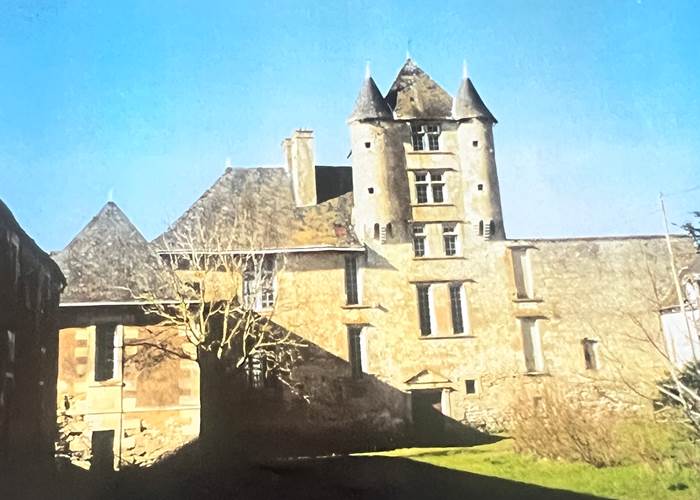
The château, which remained in the Veillechèze de la Mardière family until 1921, suffered its first damage in 1869: the north wing collapsed due to poorly executed renovations, and the occupant is said to have survived thanks to her four-poster bed. This wing was subsequently rebuilt, but on a shoestring budget; the roof was lower, and the windows were asymmetrical and lacked mullions, as evidenced by Jules Robuchon's photographs.
At the beginning of the 20th century, the estate was divided: part of the outbuildings was sold to the Chennebault family, the farmhouse and the dovecote were sold to the Boutin family; The castle was divided: the north pavilion was purchased by Mr. Didier, while the central building and the south pavilion were bought, in 1921, by Mrs. Druet. Just after this sale, a second blow struck the castle when a chimney fire again destroyed the north wing in 1922. It has remained in that state ever since.
The castle was listed in 1927 in the Supplementary Inventory of Historical Monuments.
Mrs. Druet's granddaughter, Mrs. de Benoist, who lives in Paris, regularly comes to stay in Avanton where she spends every summer. After her death in 1967, her son looked for a buyer.
Mr. Lolmède will rebuild the main building in its entirety, since after buying the part belonging to Mr. de Benoist in 1969, he acquired the north pavilion in 1977.
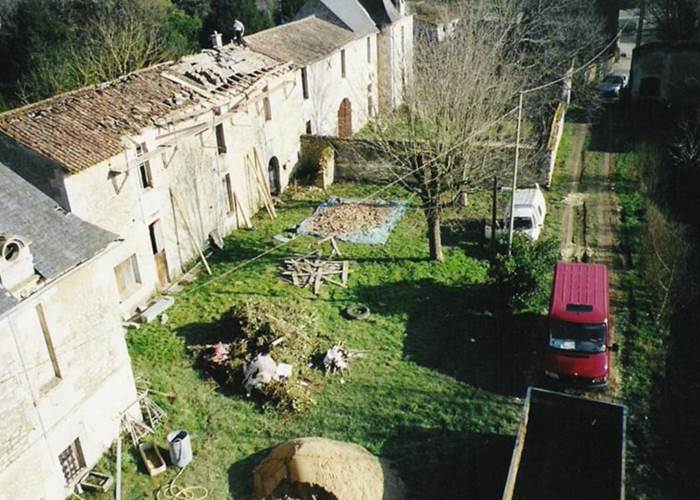
In September 2000, André and Viviane Youx became the new owners and carried out emergency repairs before moving in and rebuilding the destroyed wing: A new roof, new floors with French-style ceilings, mullioned windows and a sculpted dormer window on the north face will breathe new life into the castle.